mail: editorinchief@sikhanthology.com


What Is Miri-Piri? Understanding the Sikh Philosophy of Power

The concept of Miri-Piri represents one of the most distinctive principles in Sikh philosophy. It describes the integration of temporal authority (Miri) and spiritual authority (Piri)—a framework that encourages individuals to cultivate inner spiritual awareness while actively participating in the ethical and social responsibilities of the world.
Unlike traditions that separate religious devotion from political or social engagement, the Sikh Gurus articulated a vision in which spiritual wisdom must guide worldly action. Rather than withdrawing from society, Sikhs are encouraged to live as spiritually grounded individuals who participate responsibly in public life.
The doctrine gained historical expression during the leadership of Guru Hargobind, the sixth Sikh Guru. After the martyrdom of Guru Arjan in 1606, Guru Hargobind introduced a new model of Sikh leadership symbolized by the wearing of two swords representing Miri and Piri. This symbolism reflected a broader vision in which spiritual authority and temporal responsibility work together to uphold justice and moral order.
Meaning and Origins of Miri-Piri
The terms Miri and Piri derive from Persian vocabulary, which was widely used across South Asia during the medieval and early modern periods. Persian served as an important administrative and cultural language during the time of the Sikh Gurus, influencing political and intellectual terminology in the region.
Origin of the Word Miri
The word Miri is derived from the Persian root “Amir” or “Emir,” meaning leader, commander, or ruler. Historically, the term referred to individuals who exercised political authority, governance, or military leadership.
From this root, Miri came to signify temporal authority—the sphere of worldly power, governance, and social responsibility. In Sikh philosophy, however, temporal authority is not understood as domination or coercion. Instead, it represents the ethical exercise of power in the service of justice and the protection of society.
Origin of the Word Piri
The term Piri originates from the Persian word “Pir,” meaning elder, spiritual guide, or teacher. In Sufi traditions, a pir refers to a spiritual master who guides disciples on the path of spiritual discipline and inner transformation.
Within Sikh thought, Piri came to represent spiritual authority, encompassing devotion to the Divine, moral guidance, ethical discipline, and the cultivation of spiritual wisdom.
A Holistic Vision
In Sikh philosophy, these two spheres are not separate or competing domains. Instead, they form a holistic vision of life in which spiritual consciousness guides engagement with the world.
The Sikh Gurus emphasized that spirituality should not lead to withdrawal from society. Rather, spiritual awareness must inform ethical leadership, social responsibility, and the pursuit of justice. The concept therefore encourages individuals to combine spiritual humility with moral courage, shaping a worldview where faith and responsibility operate together.s to embody both spiritual humility and moral courage.
Historical Origin
The institutional articulation of Miri-Piri emerged during the leadership of Guru Hargobind, the sixth Sikh Guru, in the early seventeenth century.
The turning point came after the martyrdom of Guru Arjan in 1606. This event marked a significant moment in Sikh history, highlighting the need for the community to remain spiritually grounded while also developing the capacity to defend justice and protect religious freedom.
Upon assuming the Guruship, Guru Hargobind introduced a powerful symbolic expression of this philosophy. He wore two swords, representing:
- Piri – spiritual authority and moral guidance
- Miri – temporal authority and responsibility in worldly affairs
This symbolism signified that Sikh leadership would embody both devotion and strength.
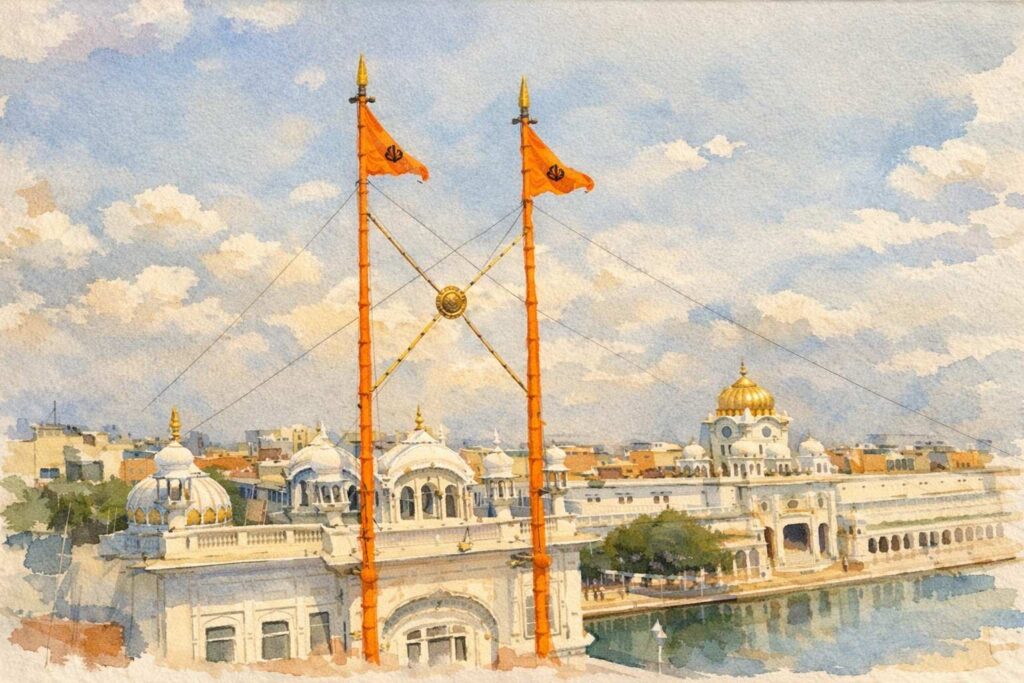
Guru Hargobind also established the Akal Takht in Amritsar as the seat of temporal deliberation and justice. The Akal Takht complemented the spiritual authority represented by Harmandir Sahib, together symbolizing the dual dimensions of Sikh life: spiritual reflection and responsible engagement with society.
Philosophical Meaning
Beyond its historical context, Miri-Piri represents a broader philosophical framework within Sikh thought.
Spiritual Authority (Piri)
Piri refers to the inner dimension of spiritual life. It encompasses devotion to the Divine, meditation, ethical discipline, humility, compassion, and the cultivation of wisdom. Spiritual authority provides the moral foundation for individual and collective conduct.
Temporal Authority (Miri)
Miri refers to participation in social and political life. It involves responsibility toward society, including the defense of justice, protection of the oppressed, and commitment to ethical governance.
The Saint-Soldier Ideal
The integration of Miri and Piri gives rise to the Sikh ideal of the “saint-soldier” (Sant-Sipahi)—an individual who embodies both spiritual depth and the courage to confront injustice. This ideal emphasizes that moral conviction must be accompanied by the willingness to act in defense of righteousness.
Modern Relevance
The philosophy of Miri-Piri continues to shape Sikh thought and engagement with contemporary issues.
Sikh Political Thought
Within Sikh political philosophy, Miri-Piri underscores that power must always remain accountable to ethical principles. Leadership is understood as a responsibility grounded in justice and moral duty rather than domination.
Ethical Leadership
The concept offers a framework for leadership that integrates spiritual awareness with public responsibility. It emphasizes that authority must be guided by humility, compassion, and ethical judgment.
Social Responsibility
In modern societies facing inequality and injustice, the principle of Miri-Piri encourages individuals and communities to engage actively in social welfare while remaining rooted in spiritual values.
Conclusion
Miri-Piri represents a central pillar of Sikh philosophy, articulating the integration of spiritual wisdom with worldly responsibility. First symbolized through the leadership of Guru Hargobind, the concept continues to influence Sikh perspectives on ethics, governance, and social engagement.
By uniting devotion with courage and spirituality with responsibility, the philosophy of Miri-Piri offers a timeless model of leadership grounded in moral integrity. In a world where authority is often separated from ethical guidance, the Sikh vision of Miri-Piri remains a powerful reminder that true power must always be guided by spiritual insight and justice.

Darvinder Singh Nanda is a legal scholar and Founder & Editor-in-Chief of The Sikh Anthology, focusing on Sikh intellectual history in Northeast India and its relationship with the global Sikh diaspora.