mail: editorinchief@sikhanthology.com

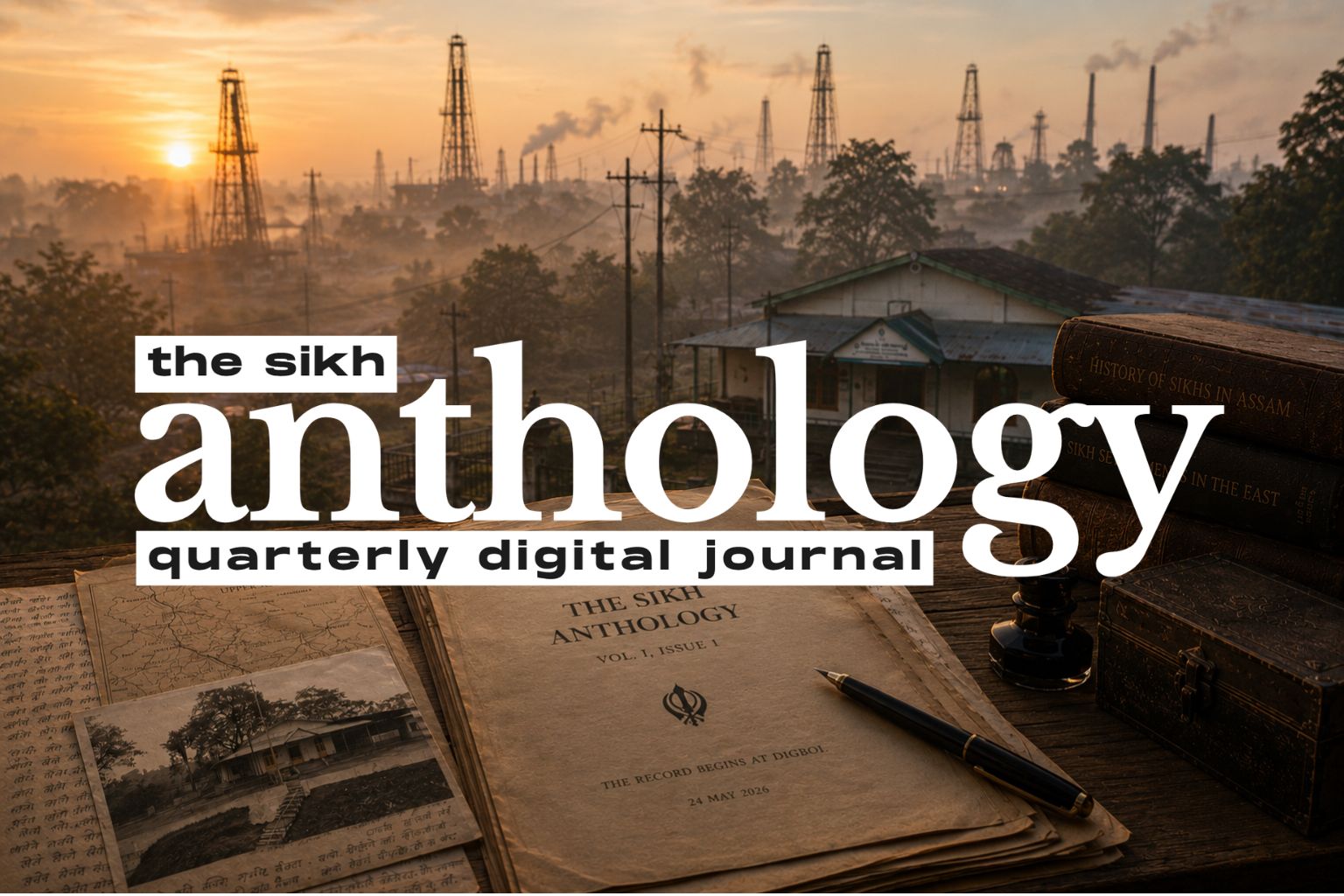
The Record Begins at Digboi — The Sikh Anthology Vol. I
The Sikh Anthology Vol. I, Issue 1 launches at Digboi on 24 May 2026 — a publication committed to documenting Sikh history and thought in Northeast India.

On the forthcoming launch of The Sikh Anthology, Vol. I, Issue 1 — and why it matters that it begins here
There is a particular kind of absence that does not announce itself. It accumulates quietly – in footnotes that trail off, in archives that were never built, in communities whose histories were told by others, or not told at all. The Sikh Anthology begins as a refusal to continue accepting that absence.
On 24 May 2026, Vol. I, Issue 1 of The Sikh Anthology will be released at Gurdwara Sri Guru Singh Sabha, Telkhad, Digboi – a town in Upper Assam that sits at the edge of what most Indian intellectual culture considers its centre of gravity. That choice of venue is not incidental. It is the first editorial statement this publication makes
Why Digboi ?
Digboi does not need to justify itself to the imagination of any other major city or town. It carries its own density of history: the oldest oil refinery in Asia, a Sikh community that put down roots in this soil long before anyone thought to document the fact, and a Gurdwara that has functioned for 100 years as an institution, anchor, and informal archive in ways no official record adequately captures.
Launching The Sikh Anthology Vol. I here is not a symbolic gesture. It is an argument about where Sikh intellectual life actually lives, and where the work of documentation is most urgently needed.
What This Publication Is — and Is Not
The Sikh Anthology is not another magazine. The distinction matters and it must be stated plainly. This is a publication founded on the conviction that Sikh thought, Sikh history, and Sikh community life across Northeast India deserve the same rigour that any serious intellectual tradition demands of its record-keepers.
That means argument over assertion. Primary sources over received wisdom. Documentation precise enough to serve researchers fifty years from now, not just readers this week.
The standard Sikh historical narrative runs through Punjab, through Partition, through diaspora westward. Northeast India appears in that narrative rarely. When it does appear, it enters as margin rather than subject. That framing is not neutral. It is a choice — made repeatedly — that this publication is now in the business of contesting.
The Structure of Vol. I, Issue 1
The inaugural issue of The Sikh Anthology carries five sections: Faith & Thought, The Northeast Record, Law Policy & Critique, Community & Institutions, and Stories & Reports. Each section is a structural commitment, not a content category.
Faith & Thought holds the theological inquiry this tradition deserves but rarely receives in sustained print form. The Northeast Record begins an archival project designed to outlast this issue, one that will accumulate across volumes into something future researchers can actually use.
Law & Policy positions Sikh community concerns within the harder discourse of rights, governance, and institutional accountability. The remaining sections carry community voices that exist today largely as oral memory, and risk becoming, without this kind of intervention, nothing more than that.
Editorial Work in the Oldest Sense
What The Sikh Anthology offers is neither devotional literature nor dry academic exercise, though it draws discipline from both traditions. It is editorial work in the oldest sense: a gathering, a shaping, a considered judgment about what the record requires and what it cannot afford to lose.
The release at Gurdwara Sri Guru Singh Sabha, Telkhad, Digboi on 24 May 2026 is, in one sense, a beginning. In another and more accurate sense, it is a declaration. The Sikh presence in Northeast India is not peripheral to Sikh history. The communities of Assam are not a regional curiosity awaiting acknowledgement from elsewhere. Serious documentation can begin from here, with the resources available here, and still produce something built to last.
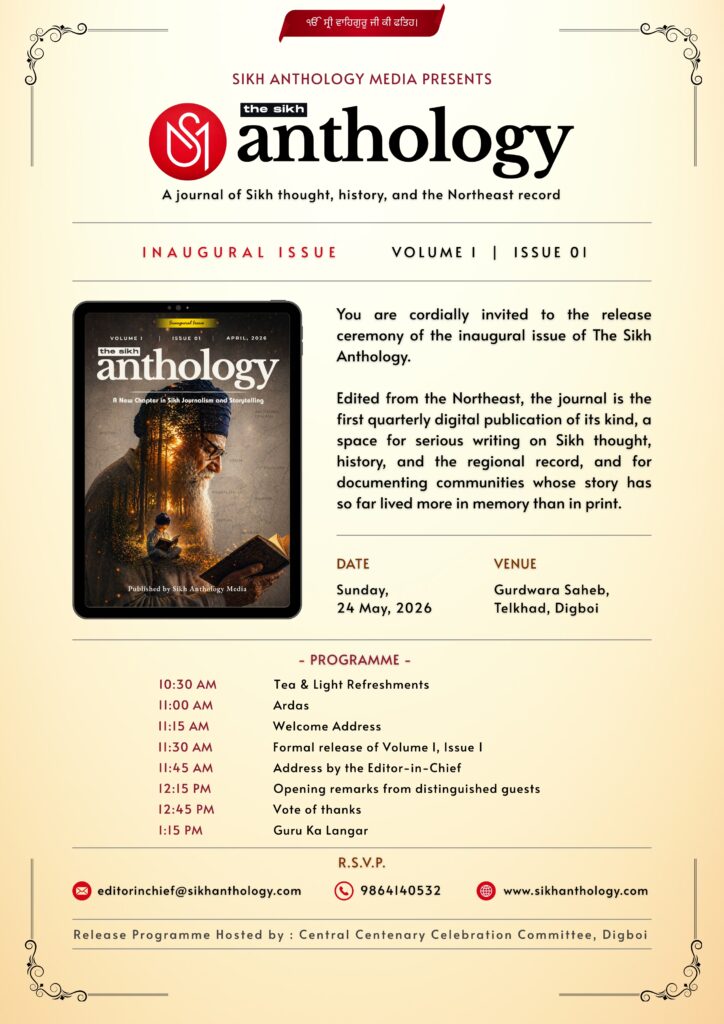
In eight days, the record begins at Digboi.

Darvinder Singh Nanda is a legal scholar and Founder & Editor-in-Chief of The Sikh Anthology, focusing on Sikh intellectual history in Northeast India and its relationship with the global Sikh diaspora.