mail: editorinchief@sikhanthology.com


Khushwant Singh: The Modern Chronicler of Sikh History

While many readers remember Khushwant Singh for his sharp wit and the celebrated column With Malice Towards One and All, his most enduring legacy lies in his monumental contribution to the modern documentation of Sikh history.
Before Singh, the historical narrative of the Sikhs existed largely across oral traditions, devotional literature such as the Janamsakhis, and scattered Persian or colonial British records. Singh was among the first scholars to apply a rigorous modern historiographical method to Sikh history, synthesizing diverse sources into a coherent and critically examined narrative. In doing so, he helped establish Sikh history as a serious academic discipline.
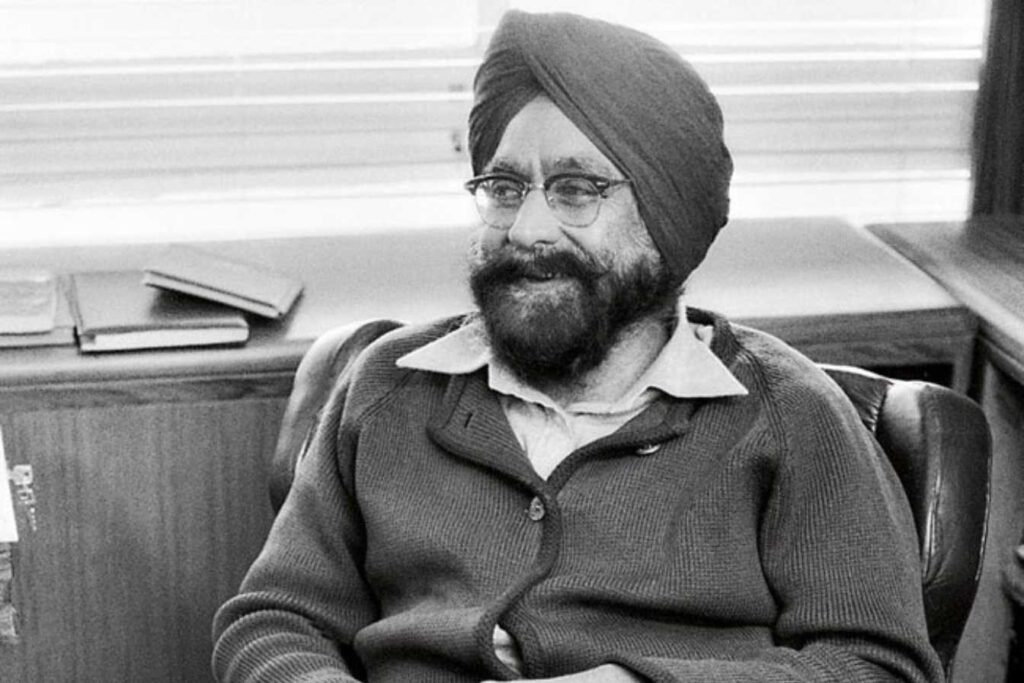
The Definitive Narrative: A History of the Sikhs
Singh’s two-volume magnum opus, A History of the Sikhs, remains one of the most authoritative accounts of the Sikh past. Written with scholarly discipline and narrative clarity, the work examines not only events but also the political, social, and cultural forces that shaped the Sikh community.
Volume I (1469–1839) traces the evolution of Sikhism from the spiritual teachings of Guru Nanak to the emergence of a powerful political community, culminating in the establishment of the Sikh Empire under Maharaja Ranjit Singh.
Volume II (1839–2004) chronicles the decline of the Sikh kingdom following Ranjit Singh’s death, the British annexation of Punjab, the Ghadar movement, the upheaval of Partition in 1947, and the transformation of Sikh identity in the modern diaspora.
Together, these volumes provide one of the most comprehensive historical syntheses of Sikh civilization.
Translating the Sacred
Khushwant Singh understood that the history of the Sikhs cannot be separated from their spiritual tradition. Recognizing the need to make Sikh scripture accessible to a wider audience, he devoted significant effort to translating and interpreting key Sikh texts.
His major contributions in this field include:
- The Japji — a translation and commentary on Guru Nanak’s foundational morning prayer, offering readers insight into the core philosophical principles of Sikhism.
- Hymns of the Gurus — a carefully curated collection presenting the spiritual compositions of the Sikh Gurus alongside contextual explanations.
- The Name of My Beloved — a poetic rendering that captures the devotional and mystical dimensions of Sikh spirituality.
- The Psalms of the Sikhs — a translation designed to introduce Western readers to Sikh theology and spiritual thought.
Through these works, Singh helped bridge linguistic and cultural barriers, bringing Sikh spiritual literature to an international readership.
Humanizing the Icons: Biographies and Historical Studies
A distinguishing feature of Khushwant Singh’s historical writing was his refusal to rely solely on devotional narratives. Instead, he approached historical figures with scholarly detachment, portraying them as complex individuals shaped by their circumstances.
This approach is particularly evident in his biographical and historical studies:
- Ranjit Singh: Maharaja of the Punjab — a detailed biography of the founder of the Sikh Empire, examining his military brilliance, diplomatic skill, and secular governance.
- Bhai Vir Singh: Life and Times — a study of the influential literary figure associated with the Singh Sabha reform movement and the revival of Sikh intellectual life.
- The Sunset of the Sikh Empire — an examination of the political fragmentation and internal rivalries that ultimately led to the collapse of the Sikh kingdom.
By moving beyond uncritical glorification, Singh offered a more nuanced and historically grounded understanding of Sikh leadership.
Preserving the Memory of Punjab and Partition
Having personally witnessed the trauma of the 1947 Partition, Khushwant Singh became one of its most powerful chroniclers. His writings capture the profound human cost of communal violence and displacement that reshaped the Punjab forever.
His landmark novel Train to Pakistan stands as one of the most compelling literary portrayals of Partition, depicting the tragic consequences of political upheaval on ordinary lives.
Beyond fiction, Singh also explored the political and social evolution of the Sikh community in works such as:
- The Sikhs Today — a sociological examination of Sikh identity and practice in post-independence India.
- Tragedy of the Punjab — an analysis of the political turmoil that engulfed Punjab during the 1980s.
- Land of the Five Rivers — an anthology preserving the literary, cultural, and historical heritage of Punjab.
Through these works, Singh ensured that the memory of a divided Punjab would remain an essential part of modern historical consciousness.
The Legacy of an Unconventional Historian
Khushwant Singh often described himself as an agnostic. Yet this intellectual distance arguably enabled him to write with a degree of objectivity rare in community histories. Rather than composing purely devotional narratives, he sought to interpret Sikh history through critical inquiry and historical evidence.
In doing so, he helped articulate a broader understanding of Sikh identity, one rooted in moral courage, historical resilience, and a distinct cultural tradition that has resisted assimilation across centuries.
Today, for scholars, students, and readers seeking to understand the evolution of Sikh history and the civilization of Punjab, the journey almost invariably begins with the works of Khushwant Singh.

Darvinder Singh Nanda is a legal scholar and Founder & Editor-in-Chief of The Sikh Anthology, focusing on Sikh intellectual history in Northeast India and its relationship with the global Sikh diaspora.